Office clearance prices depend on volume, access, the type of items and how much can be reused or recycled. Most firms quote after a free survey or from photos and give a fixed price. Published starting prices in our rankings range from £40 plus VAT in Bristol to £375 in Birmingham, but a full office usually costs considerably more.
Key points
- Price is driven by volume, floor level, parking and the mix of furniture, IT and general waste.
- Most firms quote after a free survey or from photos, so ask for a fixed written price including VAT.
- Reusable furniture and working equipment can reduce the bill, but resale value is often low.
- Check the carrier registration and ask for a waste transfer note, which your business must keep for two years.
What decides the price of an office clearance
There is no standard price list for office clearance, because no two offices are the same. The firm is pricing the space it needs in a vehicle, the time its crew will spend, the disposal cost at the other end and any extra handling.
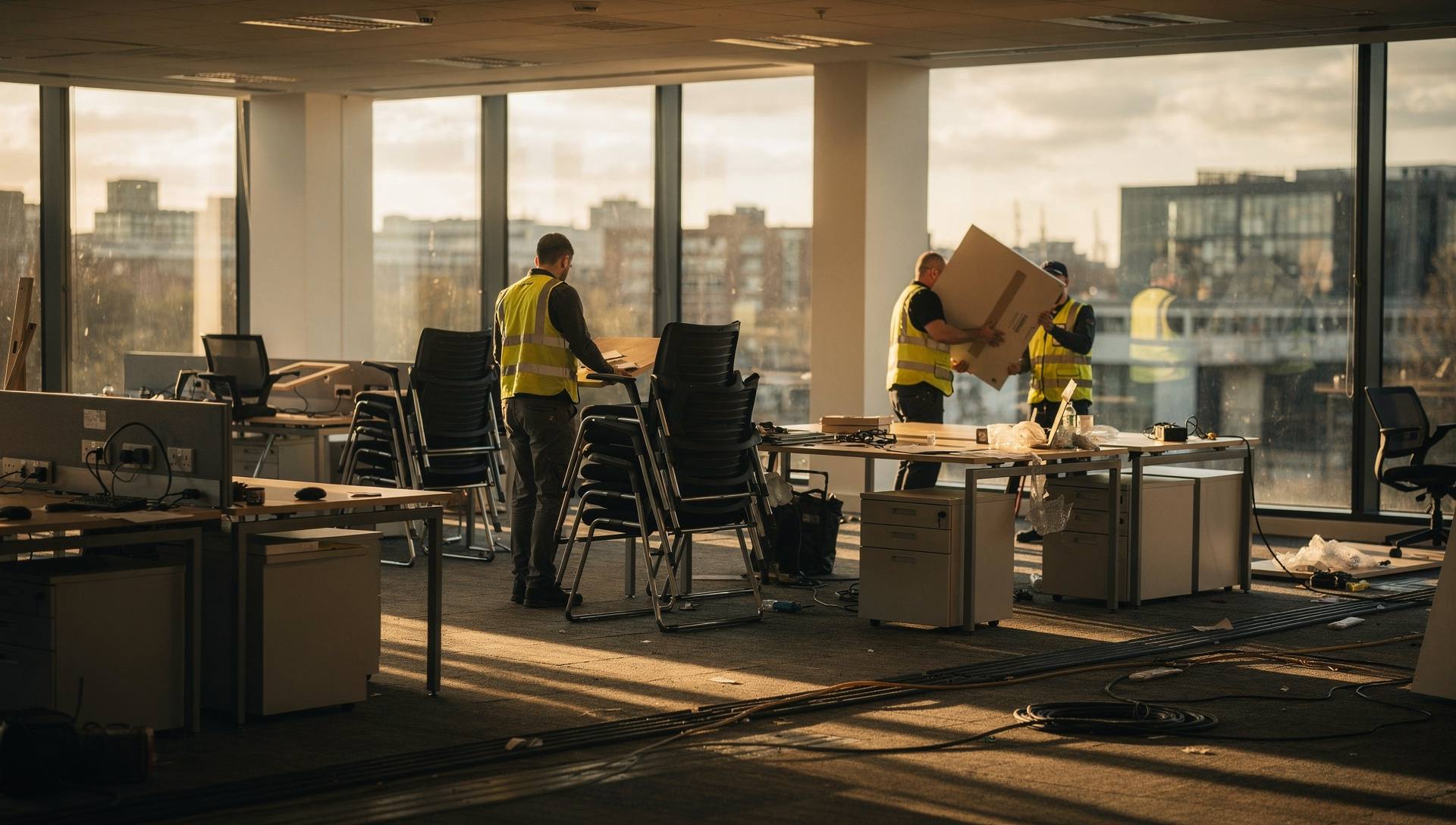
- Volume: the number of desks, chairs, filing cabinets, partitions and boxes is the biggest factor.
- Access: a ground floor unit with a loading bay is far cheaper than a fourth floor office with a small lift and no parking.
- Item mix: heavy items such as safes, large cabinets and glass partitions take longer to move and cost more to dispose of.
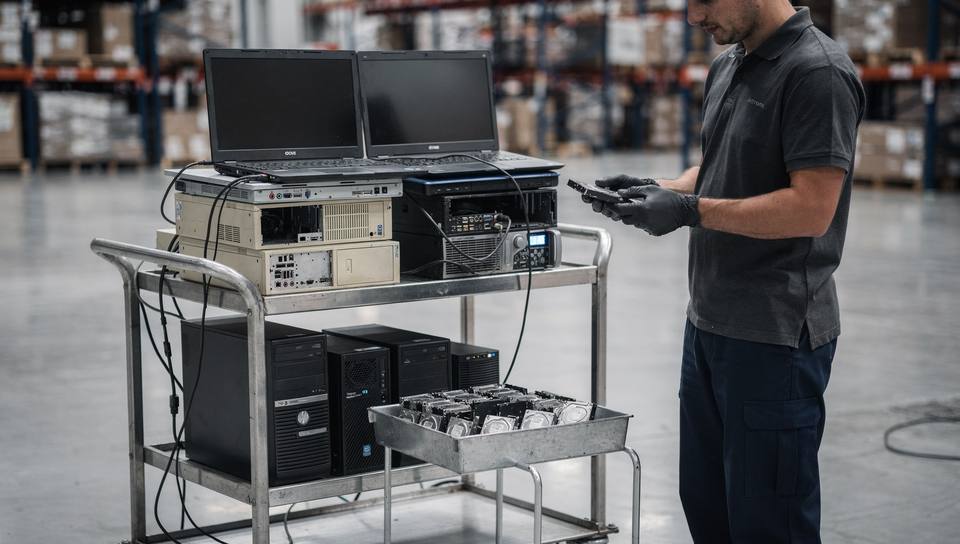
- IT and electrical equipment: computers, monitors and printers must be handled as electrical waste, and data needs to be dealt with first.
- Timing: evening, weekend and same day work often carries a premium, because the crew cannot work within normal hours.
- Reuse value: modern desks and ergonomic chairs may be resold or donated, which can offset part of the cost.
Disposal cost matters too. Mixed waste is charged by weight or volume at the receiving site, so a firm that sorts furniture for reuse and metal for recycling can sometimes quote lower than one that sends everything to a single waste stream.
Real published prices from our city rankings
Most firms in our rankings do not publish office prices at all, and that is normal for this type of work. The table below shows what was publicly listed when we checked on 3 November 2026. Treat these as starting points, not typical totals.
| City | What is published | What to expect |
|---|---|---|
| Birmingham | One ranked firm lists office clearances from £375, with a written quote before work starts | Others quote after a visit or photos. See office clearance in Birmingham |
| Bristol | One ranked firm lists clearances from £40 plus VAT, and another has a £60 minimum | Larger offices are quoted individually. See office clearance in Bristol |
| Sheffield | One ranked firm publishes a volume based price guide | Others quote individually |
| London, Glasgow, Edinburgh, Cardiff and others | No ranked firm publishes office prices | Expect a free survey, then a fixed written quote |
A starting price of £40 or £60 will usually cover a very small job, such as a few items or one room. A whole floor with dozens of workstations is a different job, so always ask for a quote based on your own inventory. You can compare firms for your city on the office clearance hub.
What is usually included in the quote
A good quote spells out exactly what is covered. Ask the firm to confirm each of the following in writing before you accept.
- Labour, loading, transport and disposal at an authorised site.
- Dismantling of workstations, shelving or partitions, if needed.
- Collection of IT and electrical equipment, with a separate arrangement for data (see our guide on what happens to computers and data during an office clearance).
- A waste transfer note for the load, which is your proof that the waste went to an authorised carrier.
- VAT, parking fees and any permit or loading bay booking.
- A sweep up or basic tidy of the space afterwards, if you need it for a lease handover.
Items that are often charged extra include hazardous waste, very heavy equipment, work that needs a lift booking, and anything that has to be carried down several flights of stairs.
Can office furniture be sold or donated?
Yes, and it is worth asking about. Good quality desks, task chairs and storage can often be reused, either by a clearance firm that resells them, by a refurbisher, or by a charity or school. Reuse keeps furniture out of the waste stream and can reduce your disposal cost.
Do not expect to be paid much, though. WRAP, the waste and resources charity, reports that the UK discards around 1.2 million desks and 1.8 million chairs every year, with only about 17 per cent of them recycled, which shows how much supply there is compared with demand. Offering furniture for free collection is often a more realistic aim than selling it.
How to get an accurate, fixed quote
- Walk the space and make a simple inventory: desks, chairs, cabinets, IT equipment, boxes and anything unusual.
- Note access details: floor level, lift size, parking, loading times and any building rules.
- Ask two or three firms for a free survey or photo quote, using the same inventory each time so the prices are comparable.
- Request a fixed written price that states whether VAT is included, and what happens if the job turns out larger.
- Check the carrier is registered and ask for a waste transfer note after collection.
- Agree who removes data from computers, and when, before the crew arrives.
If your business is VAT registered, ask your accountant whether you can reclaim the VAT on the clearance. The standard VAT rate is 20 per cent, so a quote shown without VAT is not the final figure.
Paperwork you should not skip
Your business has a legal duty of care for its waste. That means checking that whoever takes it away is a registered waste carrier, and keeping a waste transfer note for each load. The note should be kept for at least two years. Our guides explain how to check a waste carrier licence and what a waste transfer note is.
The rules are broadly the same across Great Britain, but the register differs. In England you check the Environment Agency register, in Scotland SEPA, and in Wales Natural Resources Wales. For example, an office clearance in Glasgow would involve SEPA, while one in Cardiff would involve Natural Resources Wales.
Quick answers
How much does an office clearance cost?
It depends on volume, access and the type of items. Published starting prices in our rankings run from £40 plus VAT in Bristol to £375 in Birmingham, but those cover small jobs. For a full office, ask for a fixed written quote after a survey or from photos.
What is included in an office clearance?
Normally labour, loading, transport and disposal at an authorised site, plus a waste transfer note. Dismantling, IT equipment collection, parking fees and cleaning may be included or charged separately, so ask for the quote to list them.
Can office furniture be sold or donated?
Yes. Good quality desks, chairs and storage can be resold, refurbished or donated to charities and schools. Resale value is usually modest, so free collection by a reuse organisation is often the more realistic outcome.
Is VAT charged on office clearance?
Yes, clearance firms that are VAT registered charge VAT at the standard 20 per cent rate. Some firms quote prices without VAT, so check the total. If your business is VAT registered, ask your accountant about reclaiming it.
Find a trusted office clearance firm
We rank the five best office clearance companies in 11 UK cities on reviews, licensing and recycling. Nobody pays to be listed. See all office clearance rankings.
Sources
- GOV.UK: Dispose of business or commercial waste
- GOV.UK: Waste duty of care code of practice (November 2018)
- GOV.UK: VAT rates
- WRAP: Crown Workspace leading the way in office furniture reuse
- NetRegs: Users of electrical and electronic equipment, what you must do
Prices and council fees quoted from our city rankings were checked on 3 November 2026. Rules can change, so check with your council or the regulator before you act. This guide is general information, not legal advice.