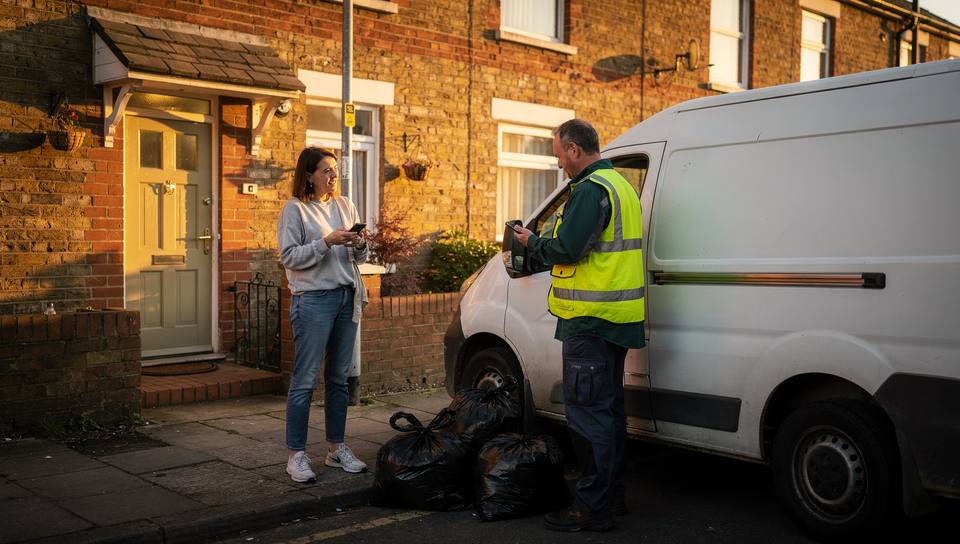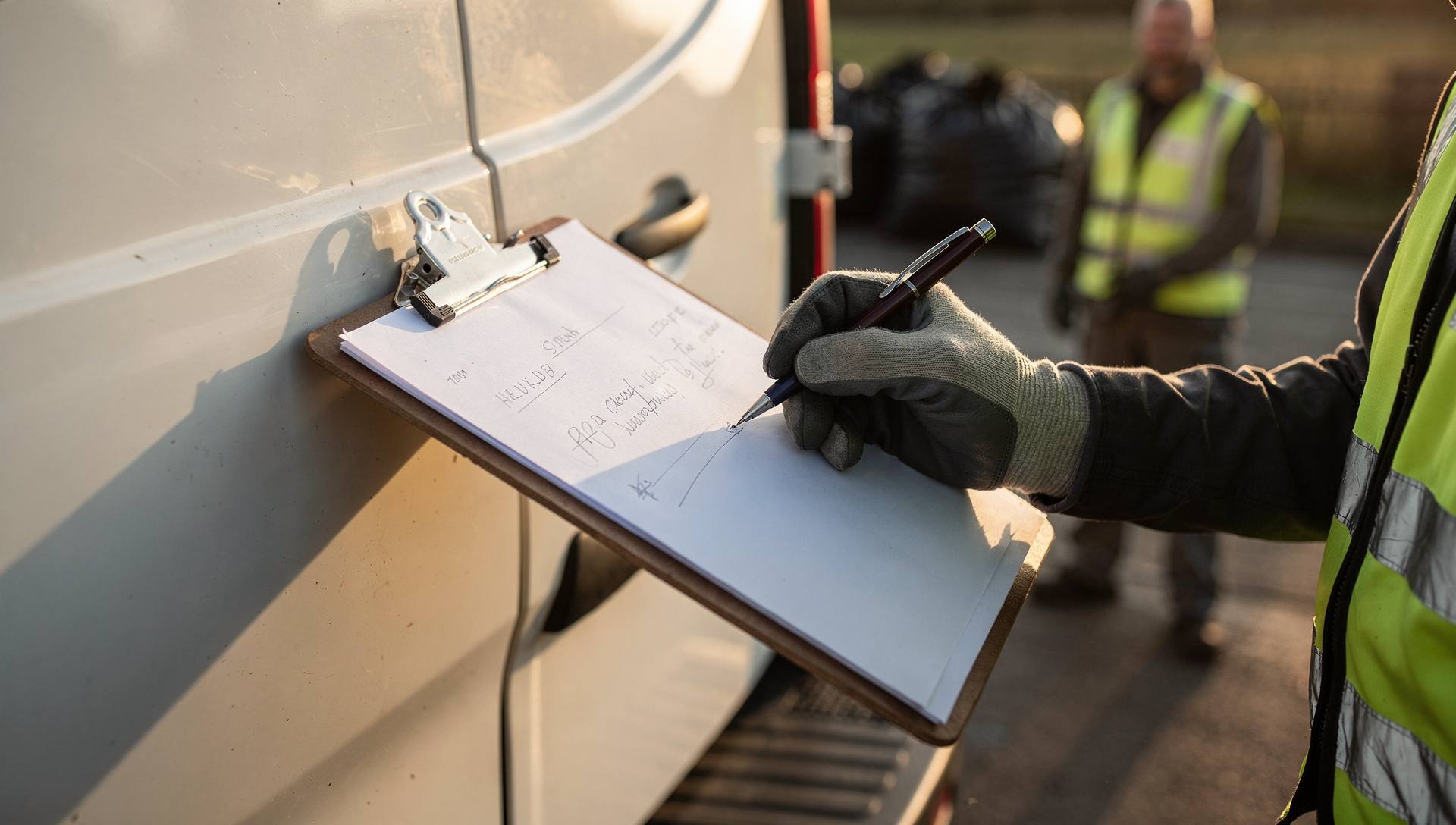
A waste transfer note is a document that records business waste being handed from one party to another. If you run a business or charity, you need one for every load that leaves your premises. Householders do not. Both sides sign it, and both must keep a copy for at least two years.
Key points
- Businesses must complete a note each time waste changes hands, and householders are exempt.
- A note records who, what, how much, when and where, plus the carrier's registration details.
- Both parties must keep the paperwork for two years, or three years for hazardous waste consignment notes.
- Scotland has its own regulations, with extra detail such as waste and SIC codes.
What a waste transfer note is
A waste transfer note, often shortened to WTN, is the written record that proves who passed waste to whom. It is part of the waste duty of care, which applies to anyone who produces, carries, keeps or disposes of business waste. The aim is simple: waste should be traceable from where it was produced to where it ends up.
The GOV.UK business waste guidance lists completing a waste transfer note for each load leaving your premises as one of your legal duties, alongside checking that your carrier is registered. For a typical business, the carrier or waste company issues the note, and you sign it.
Do I need one?
It depends on who you are.
- Businesses, charities and public bodies: yes. You need a note whenever non-hazardous waste changes hands, including from an office, shop, workshop or building site.
- Home based businesses: yes, if you hand over business waste. The household bin does not count.
- Householders: no. The Government's duty of care code of practice says householders are not subject to transfer note requirements for household waste. You still must check that your carrier is registered, which is explained in our guide on how to check a waste carrier licence.
- Hazardous waste: you need a consignment note instead of a transfer note, for all movements, including between premises of the same business. Domestic hazardous waste removed from a household is mostly exempt, but asbestos is not.
If you are clearing a commercial property, such as an office or a shop, the business is the waste producer and must have the paperwork. Our office clearance hub lists firms that can quote for this. The same applies to waste removed by a builder or tradesperson working on your premises.
What a waste transfer note must include
In England and Wales, the Environmental Protection (Duty of Care) Regulations 1991 say the transferor and transferee must sign the note when the waste is transferred. It must identify the waste, its quantity and whether it is loose or in a container, and record the time and place of transfer. It must also give the names and addresses of both parties, state whether the transferor is the producer or importer, and give the carrier's registration details.
The 2018 code of practice adds that the description should include the waste code, the nature of the waste, the transferor's SIC code and the capacity and authorisation number of each party. The signing parties should also confirm that the waste hierarchy was applied, meaning the waste was prevented, reused or recycled where possible.
| Detail | England and Wales | Scotland |
|---|---|---|
| Names and addresses of both parties | Yes | Yes, including postcodes |
| Date and place of transfer | Yes | Yes, including postcode |
| Waste description and quantity | Yes, with container type if relevant | Yes: type, composition and quantity |
| Waste code | Required in the code of practice | Six digit European Waste Catalogue code |
| Carrier or site details | Registration or permit number | Registration or licence details |
| Retention | Two years | Two years |
The Scottish rules are set out in the Environmental Protection (Duty of Care) (Scotland) Regulations 2014. They are very similar in principle, but the note must also give the transferor's SIC code and use the six digit European Waste Catalogue code, and the regulations allow electronic notes with an electronic signature.
How to get and complete a waste transfer note
You do not need a government form. The code of practice says that non-hazardous waste can be documented with an electronic system, a paper note, an invoice that includes all the required details, or a season ticket.
- Check the carrier's registration on the public register before you book.
- Ask the carrier or waste company for its transfer note, or an invoice that includes every required detail.
- Check that the waste description is accurate and specific, not just general waste.
- Check the quantity, date, place and the registration number of the carrier, then sign.
- Take a copy, and make sure the carrier signs too.
- File it, or store it electronically, for at least two years.
How long to keep it, and is it a legal document?
Yes, it is a legal record. Both the transferor and the transferee must keep the written description and the transfer note for two years from the transfer. The code of practice sets two years for non-hazardous waste and three years for hazardous waste consignment notes.
Failing to meet the duty of care is a criminal offence and the fine has no upper limit. A fixed penalty notice may be issued in some cases, such as when you cannot produce a written description when an authorised officer asks for one.
If your waste is mishandled or fly-tipped, the note is your best protection. It shows that you passed the waste to a registered carrier. Our guide on fly-tipping fines explains what can happen if you cannot show that.
Digital waste tracking: what is changing
The Government has launched a Digital Waste Tracking service. The Environment Agency says it is mandatory for permitted and licensed receiving sites in England from October 2026, with waste carriers, brokers and dealers following in October 2027. Wales follows the England date for receiving sites, and Scotland is later, from January 2027.
For now, the paperwork stays. The Environment Agency says operators must keep completing waste transfer notes alongside recording receipts in the new service. A business using a clearance firm in London or Manchester should therefore carry on asking for a note as normal.
Quick answers
Is a waste transfer note a legal document?
Yes. It is a legal record that proves the waste went to an authorised person. Failing to meet the duty of care is a criminal offence, and the fine has no upper limit, although fixed penalties may be used in some cases.
How do you get a waste transfer note?
The carrier or waste company usually provides it. There is no mandatory government form, so it can be a paper note, an electronic document or an invoice that includes all the required details. Both parties sign it.
Do I need a waste transfer note for scrap metal?
If it is business waste and you hand it to someone else, the duty of care applies and you should have the paperwork, including checking the collector is authorised. A document such as an invoice can serve as the note if it includes every required detail.
How to fill out a waste transfer note?
Describe the waste accurately with its waste code, quantity and container type. Add the date, time and place, both parties' names and addresses, and the carrier's registration number. Both sides sign and keep a copy for at least two years.
Find a trusted waste firm near you
Our city pages bring together the best skip hire, house, junk, office and garage clearance firms in 11 UK cities. Nobody pays to be listed.
Sources
- GOV.UK: Dispose of business or commercial waste
- GOV.UK: Waste duty of care code of practice (November 2018)
- legislation.gov.uk: The Environmental Protection (Duty of Care) Regulations 1991
- legislation.gov.uk: The Environmental Protection (Duty of Care) (Scotland) Regulations 2014
- NetRegs: What is the duty of care for waste?
- Environment Agency blog: Digital waste tracking goes live
Prices and council fees quoted from our city rankings were checked on 3 November 2026. Rules can change, so check with your council or the regulator before you act. This guide is general information, not legal advice.