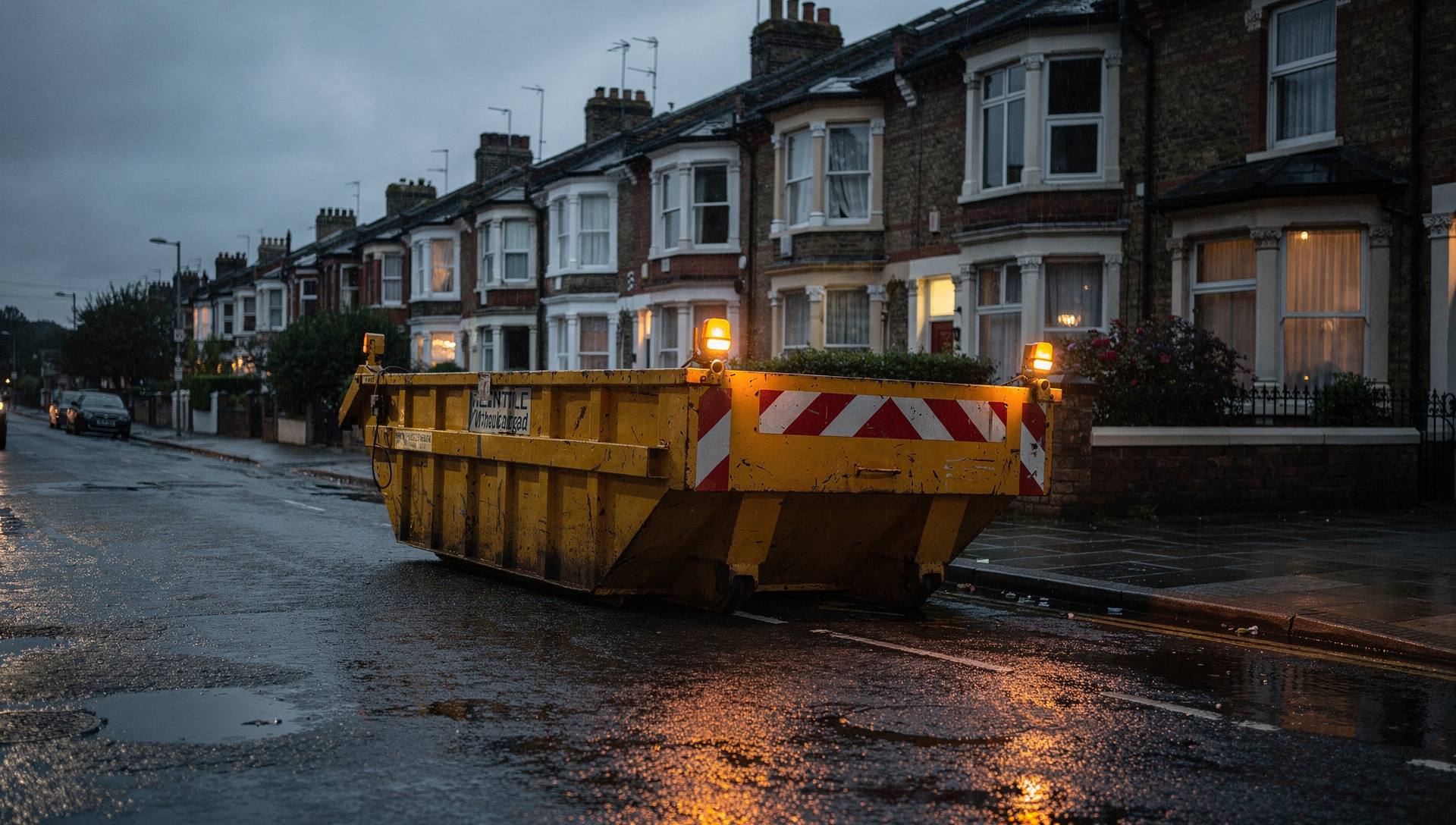
Yes. If a skip stands on a public road, including a residential street or grass verge, you need your council's permission first. In England and Wales this comes from the Highways Act 1980, and in Scotland from roads legislation covering obstructions. You do not need a permit if the skip sits wholly on your own private land, such as a driveway.
Key points
- A skip on a public road or pavement area needs permission from the local council, usually called a skip permit or licence.
- A skip wholly on your own driveway or private land does not need a permit.
- In many cities only the skip company can apply, and it is normally arranged as part of the booking.
- Fees vary hugely, from £17 in Sheffield to £90 a month in Bristol, and some councils charge extra for parking bays.
- Skips on the road must be lit at night and carry the owner's name and contact details.
When a skip needs a permit and when it does not
The rule is simple. In England and Wales, section 139 of the Highways Act 1980 says a builders skip must not be placed on a highway without the permission of the highway authority, which is normally your council. A highway includes the carriageway, and councils also treat verges and many pavements as part of it.
If the skip goes entirely on your own land, no highway permission is needed. In Newcastle, Glasgow and Birmingham, for example, the council pages confirm that no permit is required when the skip is on private property or your own drive. If part of the skip overhangs the pavement, however, it is no longer fully on private land, so check with the council.
England, Scotland and Wales: how the rules differ
Section 139 of the Highways Act 1980 applies in England and Wales. It lets the council attach conditions to a permit, and it requires the skip owner to keep the skip lit during darkness, to mark it clearly with the owner's name and a telephone number or address, to remove it as soon as practicable once it is full, and to follow every condition of the permission. Failing to do these things is an offence. Some parts of this section have been replaced for London by later local legislation, which is one reason London boroughs run their own schemes.
Scotland has different legislation. Section 59 of the Roads (Scotland) Act 1984 says nothing may be placed in a road so as to cause an obstruction unless the roads authority has given written consent. It does not mention skips by name, but councils such as Glasgow and Edinburgh apply it through road permits and road occupation permits.
Wales follows the same Highways Act 1980 rules as England, with each council setting its own fees and conditions. In practice the sensible approach in all three nations is the same: ask the council, or let your skip firm do so, before the skip arrives.
Who applies and what it costs
In most large cities you cannot apply yourself. The council expects a registered skip company to apply on your behalf, and the cost usually appears on your quote. The table below shows what each council says, taken from our own research, checked on 3 November 2026.
| City | Fee published by the council | Who applies |
|---|---|---|
| Manchester | £42 per permit, valid up to 7 days | Registered skip company |
| Glasgow | £54 first week then £36 per extra week outside the centre; £90 then £48 in the city centre | Skip company normally arranges it |
| Liverpool | £44 per skip, up to 7 days | Registered skip operator |
| Bristol | £90 per calendar month; £144 if applied for retrospectively | Skip owner, at least 5 working days ahead |
| Sheffield | £17 for up to 15 days, and £17 per 15 day extension | Authorised skip contractor |
| Cardiff | £44 for 7 days or £88 for 28 days, plus daily charges in pay and display areas | Registered skip trader, at least one working day ahead |
| Newcastle | £40 per permit, covering up to 28 days | Skip company usually applies |
| London | Varies by borough: Camden £71.50 for two weeks; Kensington and Chelsea £153 for a month | Usually the skip company |
| Birmingham, Leeds, Edinburgh | No fee is published by the council | Registered operator (Birmingham, Leeds); skip firm usually handles it (Edinburgh) |
To compare skip firms in your area, see our rankings for Glasgow, Liverpool and Cardiff, or start from the skip hire hub.
Parking bays, time limits and other conditions
A permit often covers only the road space, not the parking restrictions. In Bristol, a parking dispensation is also needed in the city centre and in residents' parking zones. Cardiff and Sheffield both add charges if the skip sits in a pay and display bay, and Sheffield also adds charges for yellow lines. In London, a skip in a parking bay may need a bay suspension on top of the licence.
Conditions are set by each council, but they tend to follow a pattern. As an example, one London borough requires the ends of the skip facing traffic to be painted yellow, a reflective strip across the top edge, an amber lamp at each corner from half an hour after sunset to half an hour before sunrise, and a secure cover whenever the skip is left unattended. It also asks for the skip to be removed within two working days of being filled.
Skips are not normally allowed to block drains, manholes or sightlines, and one council states plainly that skips cannot be placed on pavements. The skip must not be overloaded either, which links to your choice of size. Our guide to choosing a skip size helps you avoid that.
What happens if there is no permit
Under the Highways Act 1980 the skip's owner commits an offence if a skip is placed without permission, with a fine of up to level 3 on the standard scale. Councils can also issue their own penalties. Glasgow says a skip on the road without permission can lead to a £139 fixed penalty notice. Liverpool says a £200 penalty can apply on top of the £44 fee. Cardiff cites fixed penalty notices of up to £300, and Bristol warns of a fine of up to £1,000.
The skip company is usually the owner, so it normally carries the legal risk. But a refused or missing permit can still leave you with a skip you cannot use. That is why it is worth confirming who is responsible for the permit in writing before you pay.
How to check a skip is properly permitted
- Ask the firm at the time of booking whether the quote includes the permit and who applies for it.
- Ask for the permit reference or a copy once it is issued.
- Check that the firm is registered with your council, where a register exists. Birmingham publishes its list of registered operators, and several London boroughs publish approved operator lists.
- When the skip arrives, check that it carries the owner's name and a telephone number or address, as the law requires.
- On the first night, make sure the lights are working. If they are not, tell the firm straight away.
If you are weighing up a skip against other options, our guide asking whether a man and van is cheaper than a skip explains when you can avoid the permit altogether. And before you fill it, read about what can and cannot go in a skip.
Quick answers
Do I need a permit for a skip outside my house?
Yes, if the skip is on a public road, verge or pavement area, because that is a highway. If the skip is wholly inside your own boundary, such as on your driveway, you do not need highway permission. Check with your council if you are unsure.
What are the rules for skips in the UK?
In England and Wales the Highways Act 1980 requires permission, lighting at night, owner details on the skip and prompt removal when full. In Scotland, the Roads (Scotland) Act 1984 requires written consent for anything that obstructs a road. Each council then sets its own fees and conditions.
How much is a skip permit in England?
It depends entirely on the council. Among our cities, Manchester charges £42 per permit, Liverpool £44, Newcastle £40, Sheffield £17 for up to 15 days and Bristol £90 per calendar month. London boroughs vary, with Camden at £71.50 for two weeks.
How to check if a skip has a permit?
Ask the skip company for the permit reference or a copy, and check whether your council publishes a list of registered operators. The skip should also display the owner's name and a telephone number or address. If you still doubt it, contact the council's highways team.
Find a trusted skip hire firm
We rank the five best skip hire companies in 11 UK cities on reviews, licensing and recycling. Nobody pays to be listed. See all skip hire rankings.
Sources
- Highways Act 1980, section 139: Control of builders' skips (legislation.gov.uk)
- Roads (Scotland) Act 1984, section 59 (legislation.gov.uk)
- Glasgow City Council: Road permits
- Bristol City Council: Skip on a highway permit
- Cardiff Council: Skip permits
- Wandsworth Council: Road skip conditions
- Huntingdonshire District Council: Skip hire terms and conditions
Prices and council fees quoted from our city rankings were checked on 3 November 2026. Rules can change, so check with your council or the regulator before you act. This guide is general information, not legal advice.